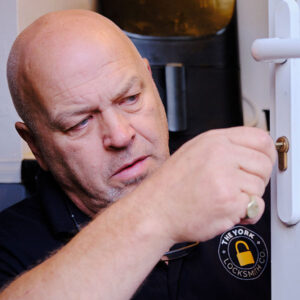
It might come as a shock that every 106 seconds a burglary takes place in the UK. This means that your front door, as the first point of entry, should be protected to the highest possible standard. It’s crucial that you invest in the most secure front door, sturdy and secure enough to protect the safety of the people and possessions you hold dearest.
Luckily there are many reliable and affordable options to choose from, so let’s delve into the most popular, security-approved types of secure doors.
What are the most secure types of doors?

uPVC Front Doors
uPVC doors are very popular across 80s builds and are still commonplace today. They’re built entirely from plastic, encasing a steel frame.
Pros: uPCV doors are popular due to their low price tags and low fuss installation.
Cons: As a door material uPVC has one of the shortest lifespans and this affects its durability. In addition, older models are prone to snapping locks.

Timber Front Doors
Timber front doors are crafted from solid hardwood which can be laminated for additional strength.
Pros: Not only do timber doors have a classy and timeless look, but they’re also strong and sturdy. At least 44mm in thickness, they are one of the best choices in terms of durability.
Cons: A downside of timber, however, is that it requires regular maintenance to preserve the material’s standard and longevity.

Composite Front Doors
Composite front doors combine the benefits of several materials as they are made from a mixture of uPVC, foam, wood, and glass-reinforced plastic.
Pros: Unlike other materials, they’re consistent on all fronts: highly reinforced, weather resistant and secure.
Cons: Composite doors can’t be painted and are one of the pricier options, even though they might be a worthwhile investment.
Conclusion
If you rank the most common secure front doors by security and durability, composite front doors are a clear winner. Compared with timber and uPVC doors, they are superior in that they are extremely hard-wearing and strong. With this in mind, it’s easy to see why they are a popular choice for the security conscious.
However, if you’re shopping around for a new front door on a budget, a uPCV door with the winning combination of an anti-snap lock and a multi-point locking system is another fantastic option. With these lock systems, you can avoid any lock snapping incidents and protect yourself against home intrusion.
Finally, if you’re quite taken with the aesthetic of a timber door you can fit it with a whole number of secure locks. Timber provides the greatest flexibility in terms of lock choice, allowing you to pick the safest options. After all, a door is only as secure as its lock.
What lock system should I choose for my door?
When there are so many options for secure locks it’s easy to get overwhelmed, so we’re going to break it down for you and share our top recommendations
It’s important to note that some lock options aren’t compatible with specific door materials. For instance, a five lever mortice deadlock won’t be suitable for a uPVC door while, in contrast, wooden doors allow for greater flexibility in lock choice.
Euro-cylinder Locks
These locks, also known as barrel locks, are fitted internally and key operated. While they are very simple to fit, they are prone to snapping if fitted poorly. Hence, why the anti-snap variety is highly recommended. Compatible with uPVC doors
Mortice Deadlocks
Mortice deadlocks are one of the most reliable options on the market as they come with the British Standard BS3621 kitemark, approved by many home insurance providers. They are embedded with the door and compatible with composite or timber.
Multipoint Locking System
Situated within the door, multipoint locking systems feature multiple locking points for added security and reassurance. Compatible with composite and uPVC doors.
How can I make my door even more secure?
There are many extra features you can invest in to make your home as safe as possible, so we’ve listed some of the easiest to implement into your home security.
Night latches
For an extra layer of security, you could consider a night latch in addition to your primary locking method.
Peepholes
Avoid opening the door to intruders by seeing who is on the doorstep before opening up.
Door chains
Door chains allow you to partially open the door to someone you don’t know, providing additional protection.
Key takeaways
There are so many ways to improve your front door security from investing in a door built from a more durable material, replacing your lock system with a more reliable option, and adding extra security features to your door.
We recommend composite doors with any insurance-approved lock pairing, uPVC doors installed with an anti-snap lock and multi-point locking system or a timber door with a strong mortice five-lever deadlock.
Want to learn more?
If you’d like to learn more about how to make your front door the most secure, consider reading some of our other guides, which explore the nitty-gritty of lock installation in more detail. We’re always here to offer expert tips and advice.