A key first line of defence for any home is a good lock – but with so many options available, it can be tricky to choose the right type of door locks for your property. Over half of Britons buy subpar door locks, making burglars’ lives much too easy.
To protect your home, family and valuables from thieves, it’s crucial to install the right security measures. Let’s look at some of the best kinds of door locks and why you might choose them, plus some additional measures to strengthen them.
Skip to
- The anatomy of door locks
- What are the 8 door lock types?
- What other kinds of door lock improvements can help protect my home?
The anatomy of door locks
Before we explore the different types of locksets suitable for front and back door use, it’s worth providing a quick explainer on their anatomy. What exactly are the parts of a door lock?
Doors have more to them than first meets the eye, containing several components. But, as a general rule, they have 3 main parts: the body, the bolt and the strike plates.
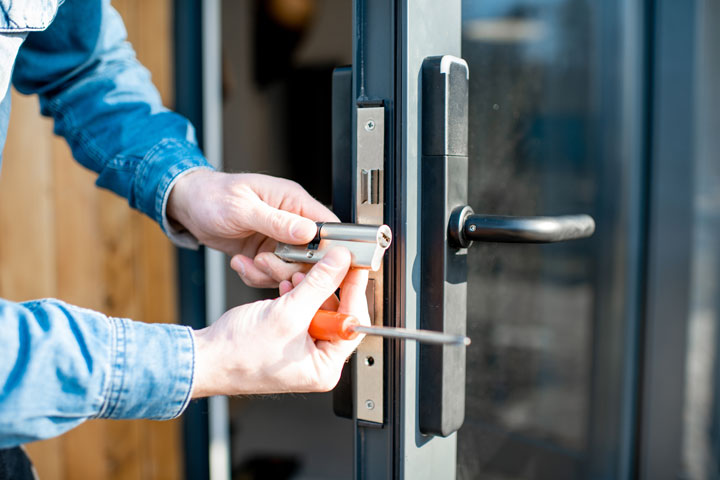
The body, which is often called the cylinder, is the part where the key is inserted. While not every door lock incorporates cylinders, any lock reliant on a key will feature a comparable mechanism that turns to activate the other components of the lock.
Then the bolt – this is the part that works to hold the door in the frame, keeping it closed. Finally, the strike plate is the component nestled inside the door frame that grasps the bolt when the door is locked.
What are the different types of door locks? 8 key categories
Now you’re up to speed with the terminology, let’s look at the 8 most common kinds of door locks that provide a good level of security for external doors. Often, these are recognisable, insurance-approved door locks. They’ll come tested against common theft tactics and will withstand a certain amount of force.

1. Mortice Locks
Mortice locks are installed on the edge of the door, with only the keyhole and faceplate visible, instead of the locking mechanism. You’ll often see a mortice deadlock installed on wooden doors and in both domestic and commercial settings.
Within the mortice lock category, you’ll find both mortice deadlocks and mortice sash locks. To easily differentiate the two, remember the following:
- Mortice deadlocks are key-operated bolts,
- While mortice sash locks are key-operated bolts that also feature a lock or catch section operated by the door handle.
These types of locks are available as either 3 or 5 lever. The five-lever mortice deadlock is a robust type of door lock. It comes with the British Standard BS3621 kitemark that many insurance policies insist on – this way, you know it provides a minimum good level of protection. As such, it’s a common choice for front doors and other exterior doors.
Pros
- Choosing a British Standard mortice lock keeps you insurance-compliant
- More difficult to copy keys from and break into than other types of locks, being drill-resistant and anti-pick.
- Mortice locks are an elegant and unobtrusive addition to any front door.
- They’re also easy to install and can be fitted in a matter of minutes by an experienced locksmith.
Cons
- Can’t be installed on doors with a thickness of less than 35mm.
- Mortice locks are more difficult to rekey than other kinds of door locks and can be tricky and/or expensive to retrofit.

2. Multi-Point Locking Systems
Commonly seen on UPVC doors and composite doors, multi-point locking systems feature at least three locking points. These points work together to create a strong locking mechanism, often activated by lifting the door handle. Once you have these points engaged, you can then turn the key to keep the door securely closed.
Multi-point systems extend from the bottom to the top of the door along the frame, giving added protection against brute force entry.
Pros
- One of the best options for uPVC and exterior doors on modern homes.
- Provides over triple the level of security of a traditional single bolt mortice lock.
- Recognised by insurance companies thanks to its functional load bearing and durability.
- The lock itself is located in a gearbox, so can be replaced independently of the multi-point locking system.
Cons
- Multi-point lock doors may cost more than traditional single-point locks.
- They can be trickier to install than single-point locks as a DIYer.

3. Euro-Cylinder Locks
Euro-cylinder locks, also known as barrel locks or “pin tumbler locks” as they were patented in 1805, are another widespread lock for internal and external doors. They are simple to fit, coming in double cylinder, single cylinder and thumb turn varieties.
Double cylinder Euro locks are operated by a key on both sides, whereas single cylinders typically only require a key on the external side, making them suited to applications such as garage doors where only external (un)locking is required.
Thumb turn cylinder locks refer to designs that can only be accessed with a key from one side – on the other side, a knob is used to open the door without the aid of a key.
All types of Euro cylinder locks, however, function in the same way. Containing a number of pins that press up against the serrated edges of the key when inserted, they are able to detect the correct pattern for unlocking.
Pros
- You can tailor the level of security to you by picking a 15-pin variety over a 5-pin variety.
- Modifiable to withstand snapping, picking and drilling.
Cons
- Unreinforced cylinder locks don’t offer the same level of security against break-ins when compared to mortice locks or multi-point locks.
- Single cylinders can be more vulnerable to break-ins as intruders could break a nearby window, reach in and activate the thumb turn mechanism from the inside.

4. Rim automatic deadlatches
The rim lock is the oldest type of door lock around. You might have heard them being referred to as a box lock because, well, they look like a box.
Rim automatic deadlatches are often fitted on the inside surface of the door, operating with a key from the outside and by hand from the inside. A rim lock provides security by locking as the door closes and can often be used in tandem with other kinds of door locks for added protection.
Pros
- Rim locks enhance the character or historical appeal of period homes.
- They’re suitable for doors where it’s not possible to install a mortice lock and internal doors that need privacy.
- Incredibly easy to fit.
Cons
- Not all door jambs / surrounds will allow the fitting of the rim lock keeper.
- They provide lower levels of security when compared to different types of locksets.

5. Deadbolt Locks
Deadbolts can be operated by a key from one or both sides, manually operated by a turn and release mechanism. This simple lock bolt is fitted into the door and has a hole for the mortice bar of the thumb turn. They don’t use a spring, so will not lock the door upon closing.
Most commonly found on internal doors in offices and other places of work, they offer moderate security but not enough for an external door.
Pros
- Suitable for internal rooms such as bathrooms or bedrooms.
- They have an easy installation process.
Cons
- Deadbolts might raise unwanted security concerns in the case of emergencies as a key is required for exiting from the inside.

6. Night Latches
Night latches (Yale locks) are a subsidiary type of rim lock that are operated from the exterior side of the door by a key and from the inside by a knob. You can usually find them on front doors, and they are mounted to doors that open inwardly and on the inner surface of the door.
The most secure night latch would be an auto-deadlocking design, which would mean that the door automatically throws the bolt into the door frame, keeping it securely closed.
Pros
- Provides simple security that has been proven to be effective for a long time.
- Deadlocking night latches will allow you to disable the handle from working inside, which is handy if the property is vacant.
Cons
- A standard night latch (non-BS 3621) isn’t secure enough for a front door alone, so it must be fitted alongside a 5 lever mortice deadlock.

7. Padlocks
Padlocks are unique kinds of locks that are not permanently attached to anything. They are portable, come in various sizes, and can stand alone. There are two main types of padlocks: combination and keyed. Keyed padlocks are further available in several subtypes, such as keyable, keyed alike and keyed differently.
Pros
- They are a good extra measure against theft or entry for garage and shed doors, for example.
- Portable, easy to use and move, they are extremely simple.
Cons
- They require fittings on a door to attach to.
- Padlocks don’t possess adequate security levels for any door of consequence and are fiddlier to unlock compared to other lock types.

8. Smart Locks
The demand for smart locks or electronic locks has surged in recent years as homes are becoming more and more connected. A smart lock is a smart home device that uses Wi-Fi or Bluetooth technology to allow users to lock and unlock doors with the tap of a finger or a voice command, eliminating the need for traditional keys.
They’re a relatively new and evolving technology that can be controlled via an app and monitored in real-time, making the experience highly adaptable and exceptionally convenient.
Pros
- Allowing synching between video doorbells.
- Smart locks can be integrated with wider smart home systems.
- You can monitor and tweak access codes and entry options.
Cons
- Smart locks are on the higher end of the pricing scale.
- They aren’t impenetrable and can be at risk of hacking.
What other kinds of door lock improvements can help protect my home?
Often, homeowners look for further locks for additional security. When that is the case, you might consider adding:
- A night latch in addition to your primary locking mechanism
- Doorknobs with a locking mechanism, especially on secure internal doors
- Improved window and patio door locks, including multi-point locking mechanisms and bolts
- Padlocks on external doors – for example, strong shackle padlocks often prevent entry to sheds and garages.
These locks should be used in addition to strong main locking mechanisms for maximum security. They’ll provide additional barriers to entry, especially helpful should a burglar overcome your primary locking method. The added peace of mind makes the cost of a locksmith more than worth it.
Over to you
Whichever lock you choose, its primary goal should be to prevent break-ins. For that reason, it’s essential to choose robust locks that conform to the minimum protection standards.
If you need help choosing your type of door lock or related accessories, get in touch today.