Think like a thief. It’s a saying that carries a lot of weight, and the police have been circulating it, particularly in conjunction with domestic burglary and the steps we can take to prevent it. Nowhere is this phrase more relevant than garages; one in four of them are burgled according to 2021 data. So, if you’ve been putting off upgrading your home security, take this as your sign to do something about it. Here in this blog, we’re going to give you a rundown of the best garage locks for both classic up and over doors, roll-ups and pedestrian doors.
10 types of garage door locks to safeguard your home
When picking out a new lock for your garage door, there are many considerations to keep in mind. From the obvious – durability, strength and weatherproofing – to the more obscure like how its visual appearance might put off would-be criminals, there’s so much to factor into your choice. For that reason, we’ve handily broken them down into categories before listing their pros, cons and door compatibility.
Traditional garage doors
An FYI before you begin to peruse the first of our garage lock suggestions: by traditional garage doors, we’re talking about the large entrance for vehicles, so up and over, roller, sectional and side hinged doors. With that said, what are you waiting for? It’s time to dive in.
1. T-handle locks
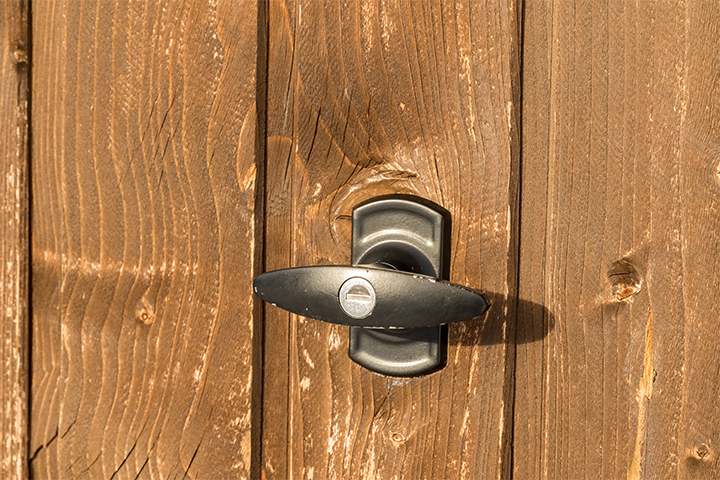
T-handle locks, also known as T-bar locks, are ubiquitous on outbuildings. If you’re not quite sure what we’re talking about, you’ve probably seen them; a T-shaped handle comprised of an external lock mechanism. This mechanism then doubles up as a handle, which you can use to manually operate the door from the outside.
Pros
- Offer easy installation you can do DIY.
- Convenient to use.
Cons
- Can be opened with brute force by hitting or snapping the lock.
- Provides little protection against peeling or crowbar infiltration from the bottom or sides of the door.
- Many T-handle models can be picked without too much effort.
- To make sufficiently secure, you need to pair them with additional measures such as garage door defenders or a sliding bolt.
Compatibility
- Classic up and over doors
2. Garage door defenders
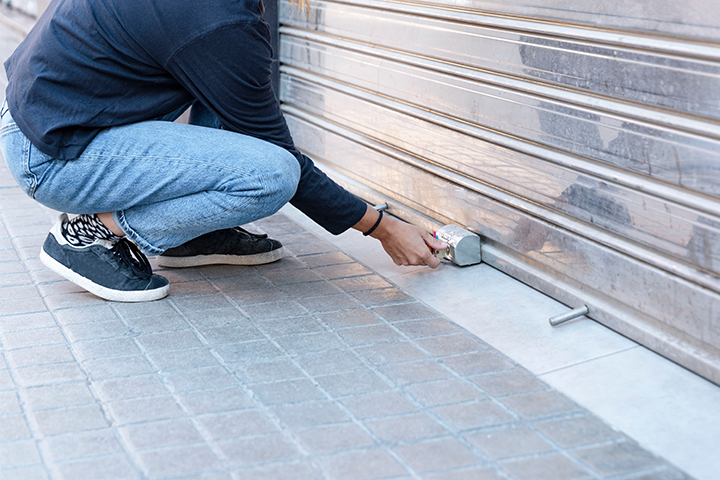
A garage door defender is a neat little contraption designed to provide an additional layer of security to garage doors that lack robustness with their original lock. You bolt it on the floor right in front of the garage door on the outside. When fitted correctly and secured with a padlock it stops the door from being opened, whilst acting as a visual deterrent thanks to their often bright colours.
Pros
- Shielded by the steel defender’s casing, the padlock is really hard to get at.
- They are both a physical and visual deterrent.
- They can withstand most brute-force attacks.
- Can come with an anti-pick design.
Cons
- You need a little room outside your garage to install it, so may pose an issue if there’s a lack of space for longer vehicles.
- A more expensive option than most.
Compatibility
- Up and over garage doors
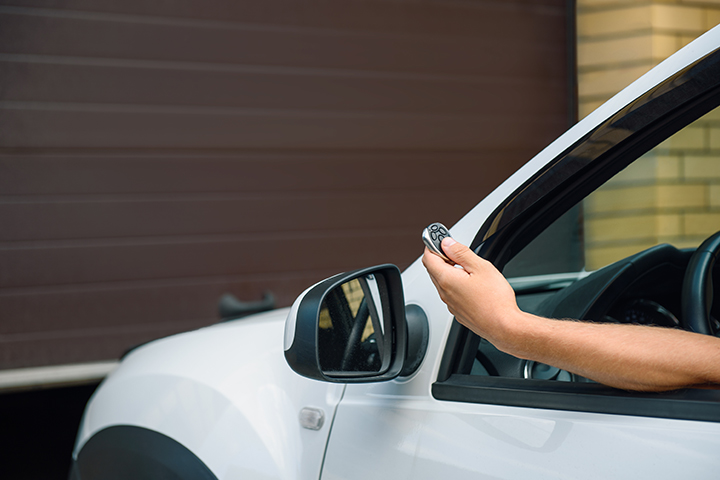
3. Digital keyless locks
Digital keyless locks are becoming increasingly popular for their convenience and advanced security features. Either battery-powered or connected to the mains electricity, they open when a remote signal is sent to the door’s control unit. These locks allow you to enter your garage without a physical key, using a code, fob or even a smartphone app.
Pros
- Convenient, as you don’t need to carry keys.
- Can be programmed with multiple codes for different users.
- Some models come with mobile app access for remote locking and unlocking.
Cons
- Some are dependent on battery power; if the battery dies, you could be locked out. Although some circumvent this issue with an emergency release mechanism.
- Subject to hacking if not properly secured.
- Often more expensive than traditional locks.
Compatibility
- Most types of garage doors, including up and over and roller doors.
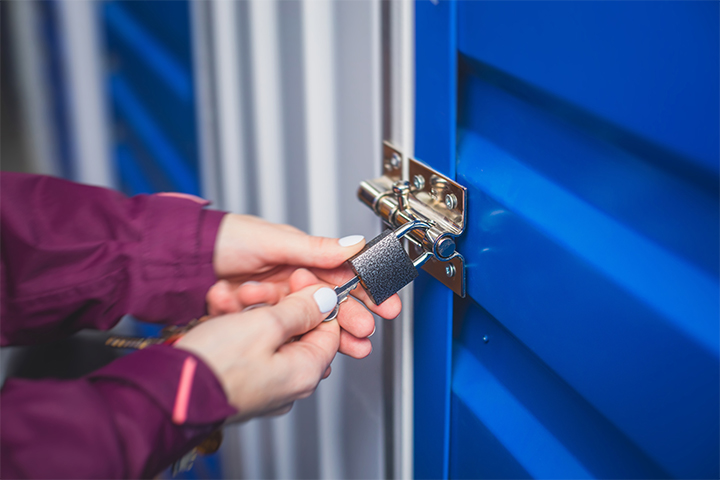
4. Sliding drop bolts
Sliding drop bolts are an excellent timesaver for those who are frequently on the go, without compromising security. They fasten the door in place when dropped into a receptacle, preventing unwanted entry, and are typically installed on the lower corners of up and over or side-hinged doors.
Pros
- Highly effective at securing the door when locked.
- Relatively easy to install and use.
- Can be used in conjunction with other locking mechanisms for added security.
Cons
- May require drilling into the floor for installation.
- Can be vulnerable if not paired with a robust primary lock.
- Not suitable for doors that cannot accommodate the sliding mechanism.
Compatibility
- Up and over and side-hinged garage doors.

5. Dead bolts
Dead bolts are one of the most secure locking mechanisms around. They’re typically manufactured from solid metal and require a key to lock or unlock on both sides, making them a favourite among homeowners whose properties are attached to the garage from the inside.
Pros
- Very difficult to pick or force open.
- Versatile, available in single and double-cylinder options, with and without thumb turns.
- Provides a high level of resistance against brute-force attacks.
Cons
- Installation can be complex, requiring precise drilling and fitting, or the help of a local locksmith.
- Can be more expensive than standard locks.
Compatibility
- Most types of garage doors, particularly up and over and pedestrian doors.

6. Bullet or pin locks
Bullet locks, often referred to as pin locks, are a robust locking mechanism designed for roller shutters and similar applications. They fit securely through the shutter curtain and into the guide rails, providing excellent resistance against forced entry.
Pros
- Highly secure and resistant to picking.
- Compact design makes them suitable for tight spaces.
Many models are weatherproof, so are ideal for outdoor use.
Cons
- Can be more expensive than standard locks.
- Some models may require specific keys, making replacements tricky.
- Installation may require professional assistance for best results.
Compatibility
- Up and over garage doors and some side-hinged doors.

7. Ground padlock
Ground padlocks are commonly used in conjunction with roller shutter doors. Mounted on the ground, these heavy-duty padlocks are slipped through the bottom of the door to secure it in place.
Pros
- Provides excellent security when used with a robust padlock.
- Easy to install and can be used with various doors.
- Highly resistant to cutting and other tampering attempts.
Cons
- May require a significant space to install effectively.
- Dependent on the quality of the padlock for security.
- Not suitable for all types of doors.
Compatibility
- Best for up and over doors
Pedestrian garage doors (side doors)

8. Euro cylinders
Euro cylinders are a popular choice for side doors, providing an excellent balance of security and convenience. Their lock mechanism consists of a cylindrical body that houses a series of pins and springs. When the correct key is inserted, it aligns the pins at the shear line, allowing the cylinder to turn and unlock the door. They are commonly found in uPVC doors and can be easily measured and replaced.
Pros
- Easy to replace if damaged or outdated.
- Available in various security ratings to suit different needs.
- Can be keyed alike with other locks for convenience.
Cons
- Some lower-quality cylinders can be susceptible to snapping.
- Not as secure as some other locking mechanisms unless upgraded.
- Requires proper installation for maximum effectiveness.
Compatibility
- Most uPVC and composite garage doors.

9. Multi-point locking system
A multi-point locking system engages several locking points along the door frame when the key or handle is turned. This mechanism typically features a central lock connected to multiple bolts that shoot into the frame at different points, securing the door in multiple locations. This design, with its force resistance, offers superior security compared to other types of traditional door locks.
Pros
- Offers enhanced security by locking at several points.
- Difficult to force open, making it a strong deterrent.
- Great for larger doors that need extra reinforcement.
Cons
- Its more complex installation process may require professional help.
- Can be expensive compared to standard locks.
- Maintenance may be needed to ensure all locking points operate smoothly.
Compatibility
- Ideal for side-hinged and larger garage doors.
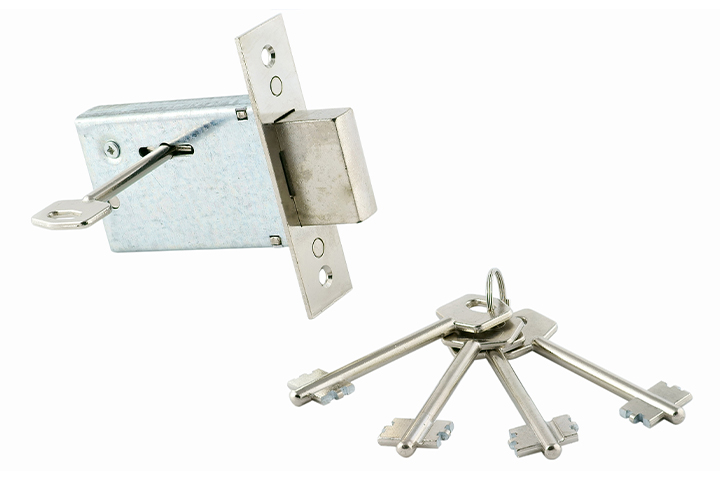
10. Mortice deadlocks
Mortice deadlocks are an excellent option that meets the British Standard, providing added security, particularly for pedestrian access. Operating with a robust locking mechanism that fits into a pocket (or mortice) cut into the edge of a door, it typically features a deadbolt that is manually operated by a key from either side. When locked, the bolt extends deep into the door frame, making it highly resistant to tampering and forced entry.
Pros
- Extremely secure and difficult to pick or force open.
- Available in various security ratings, including insurance-approved options.
- Aesthetic appeal, as they sit flush with the door.
Cons
- Installation can be complex and may require professional fitting.
- More expensive than surface-mounted locks.
- May not be compatible with all door types, especially those without enough depth
Compatibility
- Wood and composite pedestrian doors.

Bonus tips for protecting your garage from criminals
So, you’re settled on your choice of a new garage lock. Great! But did you know that there’s plenty more you can do to protect your valuables? Here are just a handful of improvements you can make, that create a tangible difference, even if you might not see it visibly.
Upgrade the door
We’ve said it in previous blog posts, but it can’t hurt to reiterate: your lock is only as secure as your door, and vice versa. If the door can be rammed, prized open with a crowbar or otherwise broken into, that’s a no-no.
So if you’re prepared to shell out the money for a high-end lock, also consider whether the door could be upgraded too. If you do a preliminary search, you’ll find that roll-up doors, in particular, are notoriously easy to get through – see this 10-second demonstration by The Garage Door Centre.
If you don’t want to replace the entire door, understandably, you could tweak it slightly with a number of reinforcements. For one, adding a lip or cutting a channel for shutters is a clever way to prevent them from being levered up, while flip doors can be strengthened with additional braces on their rear panels. Lastly, lock body protection, a sort of protective plate behind your lock, can really ramp up your door’s tamper resistance.
Interior garage barriers
Similar to the heavy-duty, temporary bollards high street shops put in their windows to prevent break-ins, you can install a thick, steel barrier inside your garage to fend off any type of attack. This measure, although more extreme, is certainly worth it in more affluent areas where nice cars and large houses tempt would-be offenders. There aren’t many physical deterrents as powerful!
Fit a security alarm
If someone starts tampering with your garage door, you want to know about it. A security alarm does just that. Catch the perpetrator in the act and you can prevent the burglary from being carried out, whilst buying time for the authorities if they have been alerted.
Implement automatic lighting
Well-lit areas are trickier hunting grounds for criminals seeking to enter your garage and, if you are lucky, the light clicking on might frighten them into scarpering. Don’t just take our word for it; in a New York trial, they discovered that implementing outdoor lighting led to a 39% reduction in index crimes.
Frost any windows
Your items are safer when criminals can’t ogle them. This means frosting any windows that they could peer into or sticking up some reflective film to foil their plans (pun unintended!).
Get insured
Lastly, if worse comes to worst, and you do experience a break-in, you’ll want to be insured so any damage or theft can be reimbursed. Here, it’s crucial to be aware of what is covered under your current plan; sometimes, you’ll find in the Ts&Cs that outbuildings aren’t included or that your cover is invalidated because you chose an uninsurable lock. Definitely dig deep into your policy to make sure these aren’t the case, and upgrade the lock if you find it’s not insurance-approved.
Final thoughts
There’s so much you can do to reinforce the security of your outbuilding, but fitting it out with one of the best, most robust types of garage locks is the easiest first step. From there, anything you do simply compounds your security. Resist the urge to put our suggestions on the back burner; criminals aren’t going to wait around. Besides, with the right measures in place, it will do wonders for your peace of mind.