Knowledge is power. How many times have you heard that phrase thrown about? Well, in the home improvement space, it’s still gospel. And, when it comes to home security specifically, it definitely carries a lot of weight. After all, fixing a lock isn’t just about smoothing over an inconvenience, but restoring your home’s safety for all its inhabitants. This segues nicely onto our topic for today – changing a lock barrel on a uPVC door.
Whether you’re upgrading your own home or fixing up a rental property for your tenants, there are a whole host of reasons why you might want to or indeed need to replace the original barrel lock. The best part is that it’s super easy to do, even if you’re new to DIY, and only takes 5 minutes to complete.
Just note that a barrel lock replacement can’t be done without the key, so if you’ve lost, damaged or misplaced it, you’ll be in need of professional assistance. Safe to say, you’ll want the job done quickly, so in this case, you should reach out to a local emergency locksmith.
What we’ll be covering in this guide:
- How to Change a uPVC Door Lock Barrel in 7 Steps
- Barrel Lock Maintenance
- When You Need to Change Locks on Your uPVC Door
- Frequently Asked Questions

The Preparatory Steps for Changing the uPVC Lock Barrel
Identifying the Lock
This might seem like an obvious point, but before we get to the main bit – how to change the lock barrel itself – you should double-check what sort of original lock you’re dealing with.
If your dwelling is a new build home, chances are the doors are uPVC, and if they’re uPVC, you’ll probably be dealing with barrel locks, or cylinders as they are also known. This isn’t always the case though, so make sure to check.
Lock Type
There are several locking mechanisms that are compatible with uPVC doors; multi-point locking systems, euro cylinders and deadbolts are the most common, and will sometimes appear in combination. If you’re unsure which yours is check out our guide to the types of door locks found in the UK.
Quality
The most secure front door locks are those that meet the UK’s stringent safety standards, and by this, we mean BS3621 British Standard. This grade of lock is robustly tested for strength, performance, and resistance against picking, making it insurance-approved. You can tell your lock meets BS3621 British Standard by looking for a kite mark engraved somewhere. If you can’t see one, this is your sign to change the lock.
Measurements
Next up, the measurements. When replacing a barrel lock, it’s important to carefully measure the cylinder, so you get a precise fit with the new one. For advice on how to do this correctly, take a look at our dedicated guide.
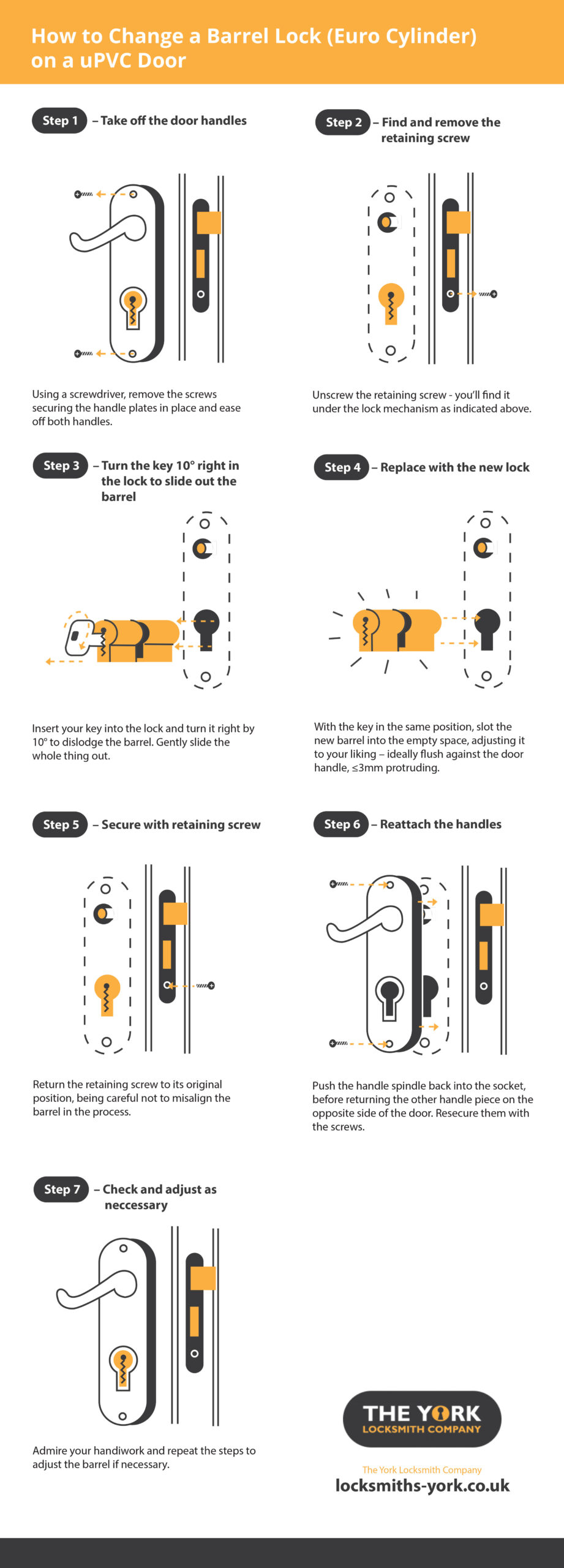
How to Change a Barrel Lock (Euro Cylinder) on a uPVC Door
What you’ll need
Just a screwdriver and the new lock!
Step 1: Take Off the Door Handles
To get the best access to the barrel lock wedged in the door, you’re going to have to take off the door handles first. This is a straightforward task – simply open the door, ensuring it’s propped open and won’t close mid-operation.
Then take your screwdriver and begin to remove the 2 screws holding the door handles in place. You’ll find them on the door handle plate on the inner side of the door, above the handle and below the keyhole.
Now both parts of the handle – inner and outer sections – will slide off slowly. Be careful to ease them out gently and avoid dropping them on the floor as you could damage them.
Step 2: Pinpoint & Remove the Retaining Screw
With the door handles removed, it’s time to tackle that barrel. First find the lock barrel retaining screw, keeping it in place.
You will always locate this crucial screw on the edge of the door that sits in the frame, centred right under the lock mechanism. Sometimes it will even be a different colour to the rest of the metal internal section of the door.
Got it? Then take your handy screwdriver and remove that screw, popping it in a safe place once it’s out.
Step 3: Slide Out the Barrel
To remove the old barrel/cylinder, insert your key into the lock and turn it slightly to the right (some say to about 10 degrees). Here, you should be able to feel when you’ve twisted it to the right spot as you can gently ease out the barrel. When its dislodged, pull the whole thing out and set it aside.
Step 4: Replace with the Shiny New Barrel
Now to fit the new lock barrel. First, you’re going to insert the new key into the new lock just as you did the first time round with the old one – turn it slightly to the right. With the key in place, slot it into the now empty slot in the door, being careful to get the front and back sides the right way round.
Adjust the placement to your liking, ensuring that when you turn the key it operates normally and the barrel is snug. We’d say that the front of the cylinder ought to be long enough to sit flush against the door handle, but not so long that it sticks out more than 3 mm.
Step 5: Secure the New Lock with the Retaining Screw
When you’re happy with the placement of the barrel, get ready to return the retaining screw to its hole. Use the screwdriver to screw it back in, being careful not to misalign the cylinder. It might take a tiny bit of trial and error, but once you’ve got it, you’ll be good as gold.
Step 6: Reattach the Handles
With the lock nicely snug and secure, the handles can go back on. Get the side of the door handle with the spindle and return it to the handle socket, pushing the spindle through the hole in the door. Now, with the other piece of the handle, fix it on the opposite side of the door, sitting snug in the spindle hole.
With both parts of the handle properly inserted, you can put the two screws back in place. Make sure it’s properly tightened, so the handle plates don’t rattle.
Step 7: Check Your Handiwork & Adjust If Necessary
Finally, you can step back and admire your handiwork. If you do notice that the lock isn’t as flush as you’d like or it’s protruding too much, you can follow the previous steps to readjust, and if it’s loose, have another go at tightening those screws.

Barrel Lock Maintenance
As we covered in our blog talking about the issues preventing doors from locking, uPVC door locks are prone to a set of unique problems. Fortunately, you can pre-empt them by following a couple of precautions. First, to keep the internals in good nick, every 3-4 months you can apply a graphite lubricant to the locking mechanism by feeding it in with the key. Second, you should always avoid closing the door with excessive force.
When You Need to Change Locks on Your uPVC Door
As we’ve established, many circumstances might compel you to change the locks on your uPVC door(s). Of course, it will look a little different depending on your unique circumstances. As a homeowner, your priorities might lie in preserving your peace of mind and ensuring your home insurance isn’t invalidated by a sub-par lock, while landlords and business owners might be more concerned with the safety of their tenants or employees.
Here’s an inexhaustive list of the main ones:
- You’re changing the locks on a rental, between tenancies.
- The current locks are poor quality, out-of-date or uninsurable.
- The property has been broken into.
- You’ve been locked out, with no other options for access.
- You’re updating the locks after buying a house.
- You want to improve your home security or business safety.
If any of the above examples describe your situation, it’s a good idea to switch out your old barrel locks with shiny new ones – even if you’re not so sure about the process.
While there’s a narrative going round that nowadays people (and the younger generations especially) lack the essential life skills to do basic DIY tasks, one third of Brits are actually more likely to try their hand at home repairs since the cost-of-living crisis. This means you’re not alone in this venture. But, if worse comes to worst, and you’re not up for it, remember that a local locksmith can tackle the job for you.
Signs You’re Due an Upgrade
We’ve covered the general reasons why you might want to upgrade your locks, but what are the red flags associated with a barrel lock that is past its best? Here are some signs to look out for:
- Your door won’t lock properly or there’s a loose feel when the lock is engaged.
- The barrel is loose in the door (i.e., sliding back and forth) or protruding more than it should.
- The handle is faulty.
- The lock is visibly damaged or rusted.
- It’s a struggle to engage the locking points.
- The key operation feels wrong, possibly stiff or sticking in the lock.

FAQS on Changing a Lock Barrel on a uPVC Door
Can I Change a Lock Barrel (Euro Cylinder) Myself?
Absolutely! Well, as long as you have the working key. This is an incredibly beginner-friendly DIY, so if you feel capable and want to save a bit of money, we’d definitely recommend it.
How Long Does It Take to Change a uPVC Door Lock Barrel?
The process of changing a lock barrel on a uPVC door takes only about 5 minutes alone, but if you factor in measuring the old lock, it’s more like 10 minutes. Plus, you will have to purchase the new cylinder.
How Much Will a New Barrel Lock Cost?
This varies depending on a cocktail of different factors. For one, are you DIYing it, or sending for a locksmith to do the job? Here’s a detailed price guide on changing locks if you need it.
Then there’s the matter of the barrel itself; these cylindrical locks can cost anything between £10 for budget options and £50 at the higher end of the scale. For these more expensive options, you are typically paying more for the luxury of added features like anti-bump, anti-pick and anti-snap protections.
See? It wasn’t so tricky
As this article draws to a close, we hope that you’ve realised that changing a uPVC door lock barrel isn’t so hard after all. All it takes is a bit of keen measurement, screwing and unscrewing and researching which replacement lock to go for. It really is that simple!
Remember, if you don’t have access to a working key because you’ve been locked out or it’s gone missing, the only way to replace the locks is with specialist tools. So, this is your prompt to get in touch with a local locksmith.