Break-ins and burglaries are horrible things to experience at home, but make no mistake, they’re equally, and oftentimes more, distressing when they occur in the workplace. After all, that’s your livelihood, colleagues, and mental health at stake.
As a master locksmith and ex-security professional, I have two decades of experience safeguarding business premises. And in my time, I’ve encountered many shortcuts and preventable office security lapses.
To avoid these stressful and sometimes costly mistakes, take stock of these workplace security tips. Starting with helpful habits and working up to higher-investment solutions, I’ll help you deter criminals, stay insurance-compliant, and maintain the peace of mind of you and your staff. Without further ado, let’s dive in.
Contents:
- Why It Matters
- It’s Broader Than Many Business Owners Realise
- Office Security Tips
- Common Mistakes You Can Easily Avoid
- The Bottom Line
Why Office Security Matters
According to the 2025 Security Benchmark report, loss prevention and asset protection sit among security leaders’ top 7 biggest concerns. However, for many business owners lacking relevant experience (particularly new start-ups and SMEs), office security gets drowned out by more immediate concerns, read: running the daily operations of the business.
Beyond the financial consequences of theft, here are a few reasons why, as an employer or office manager, it should sit higher up your list:
- Duty of Care: More than a mere practical concern, office security is directly tied to an employer’s legal duty to protect people, data, and property. If you fall short, this might undermine your legal duty to provide a safe working environment according to the Health and Safety at Work etc. Act 1974.
- Data Protection Obligations: Besides physical assets, you also need to protect sensitive information under GDPR and safeguard company IP.
- Premises Liability & Insurance Requirements: If you’re not taking adequate measures to keep the office reasonably secure as a minimum, you may be at risk of voiding insurance policies and accruing liability following incidents.
Robust Office Security is Broader Than Many Business Owners Realise
Although crime rates are broadly trending downwards, in my neck of the woods, Yorkshire, we have some of the highest rates of burglary. And, even in so-called low crime areas, the risk is never zero; indeed, crooks are hedging their bets on businesses that cut corners with their office security.
Thus, to protect your property and people, action must be taken. Unbeknownst to numerous offices, this goes beyond the usual door and window checks.
Risk Alignment
No two offices are the same. Locations differ, and so do the specific risks involved. For instance, a business premise based in the heart of an urban hub like Leeds might expect antisocial behaviour or spontaneous acts of petty crime, whereas those based in more rural areas tend to receive less high risk.
Likewise, risks vary along with the contents of the office buildings. Expensive equipment, think: PCs, monitors, cameras, high-end printers, or even servers, is a magnet to opportunistic thieves. And, counterintuitively, empty premises might be at greater risk, given the lack of security presence – a field day for would-be squatters.
My recommendation: Identify all assets that need protection, be they technology, equipment, or intangible things like data and IP. With that list of integral assets, carry out a risk assessment that prioritises each threat and devise an action plan (the later tips will help you out here).
Continual Monitoring
Office security isn’t a one-and-done exercise; to maintain its potency, business owners have got to think long term. That means continually monitoring your office security and conducting regular assessments, so that the business is being proactive rather than reacting to incidents as and when they might occur.
My recommendation: Schedule semi-frequent security audits that cover all potential entry points into your office (doors, windows, fire exits, gardens, car parks and balconies) and check in on the effectiveness of your security measures from time to time.
Culture & Internal Policy
Developing a proactive, “security-first” culture has a tangible impact on business success. For one, it means hazards are reported earlier and more efficiently, thereby improving overall safety. By the same token, more confident, psychologically safe staff equal more productive workers.
My recommendation: Set out a security policy in writing and distribute it among staff; this is particularly important for those responsible for lock-up at the end of the day. If in doubt, invest in training to ensure all employees are adequately educated on workplace security.
Office Security Tips
Once you have evaluated your current office security situation, it’s time to weigh up the appropriate control measures. You likely won’t need to implement every single one, but the more deterrents, the higher the chances that criminals will move on to a more vulnerable hit spot.
1. Upgrade External Locks on Windows & Doors…
External doors and windows are one of the most common entry points burglars target, so getting the locks right is your first line of defence. I strongly recommend upgrading to high-security hardware to make forced entry much more difficult from the outset, but you might also need to upgrade the door or window itself if it’s not up to par. For convenience, you can get them keyed alike.
Case In Point:
I recently attended a shop in York after an attempted break-in where the burglars tried wrenching off the rear door cylinder with what looked like a huge pair of pliers. The sacrificial section did its job and snapped flush, stopping entry, and I upgraded it to a 3-star cylinder that’s far more resistant to attack.
Safe Lock Option
Here’s a quick rundown of which locks are typically the safest bet:
- Five-lever mortice deadlocks: These are compatible with wooden doors and are operable by a key on both sides. Ensure they meet the BS3621 standard for contents insurance purposes.
- Multi-point locking systems: Typically found on uPVC doors, these secure the door at multiple points along the doorframe and are pretty robust, provided they meet the BS3621 standards or equivalents such as TS007 3-star rating.
- Euro cylinder locks: Normally used along with a multi-point system, you can find options with in-built security extras, such as anti-drill, anti-pick, and anti-bump properties.
Note that rim locks and night latches on their own are not up to scratch.
For more in-depth insights, check out my dedicated guides to window security and picking the most secure front doors.
2. ….And Then Reinforce Them With Physical Barriers
Good locks are your first line of defence, but I always recommend backing them up with physical barriers like security bars or shutters. It adds another layer that most opportunists won’t bother trying to get past.
3. Hide Valuables from External View
If you can see expensive kit through a window, so can a burglar. Keeping valuables out of sight reduces temptation and makes your premises less of a target. Think of it as the path of least resistance.
4. Lock Down Valuables Like Monitors & PCs
This is a tactic I’ve seen a lot in public facilities, like schools and libraries, and it works just as well in an office or indeed any workplace. Using anchor points or locking cables for things like monitors and PCs drastically reduces the risk of theft. Even if someone gets in, it makes it much harder for them to walk off with your equipment.
5. Lock Internal Doors At Night, Particularly To Rooms Containing High-Value Items
Internal doors are often overlooked, but they can slow a thief down significantly, especially when they’re on a time crunch or you’ve got additional deterrents at play. I always advise locking up key rooms overnight to protect your most valuable information and/or equipment.
6. Keep Sensitive Material Locked Away
Paperwork and sensitive data are just as valuable as physical items. A decent cabinet lock or safe goes a long way in keeping that information secure. Even if you’re not dealing with high security information, or deal with the ‘important stuff’ like a government contract, if you store customer information, protecting it falls under your GDPR duties.
7. Invest in Security Lighting & Alarms
Well-placed lighting and a reliable alarm system can put most burglars off before they even try, so place them in the most prominent places possible, including the most concealed entry points. Here, their presence alone may be enough to stop an attempt, but, of course, don’t forget to pair them with my previous suggestions.
8. Consider Lock Boxes for Cleaning Staff & Other Contractors
Instead of handing out spare keys willy-nilly, I recommend using a secure lock box to keep the control in your hands and reduce the risk of keys going missing or being copied. Needless to say, the hassle of recutting all of your keys or having to upgrade the door locks themselves isn’t worth it. To ensure that they meet insurance requirements, I’d opt for one that is either LPS1175 Issue 8 standard or meets any other ‘Police Preferred Specification’.
9. Enforce a Tiered Master Key Hierarchy
A master key system allows one key to open multiple locks, while individual keys only work on specific doors. Integrating this setup in tiers allows you to control access tightly, without giving staff any more access than they need and, as the manager, you’ll only need one key rather than a cumbersome bunch for each door, window and cabinet.
10. Train Employees
Even the best security can be undone by simple mistakes. And to avoid them, everyone needs to be on the same page. This entails comprehensive security training on the part of staff, especially those who handle different types of keys and access passes.
11. Make CCTV Systems More Visible
CCTV works best when it’s clearly visible. Indeed, longstanding data reveals that outdoor cameras help deter crime by up to 50%. A similar study carried out by the College of Policing found that CCTV has a “very strong” impact on crime, in terms of prevention, identifying offenders and even crowd control. So pop those cameras front and centre, or pair them with the classic “smile you’re on camera” signage.
12. Add Motion Detectors to Internal Rooms
Internal motion detectors add another layer once someone’s inside, which may well prevent trespassers from moving further inside. These handy devices are especially useful for covering areas that shouldn’t see movement overnight, allowing you to cover those weak spots.
13. Implement Access Control Systems
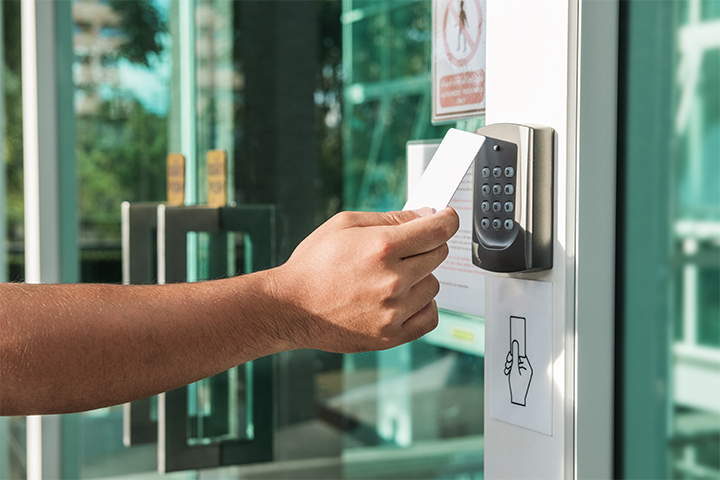
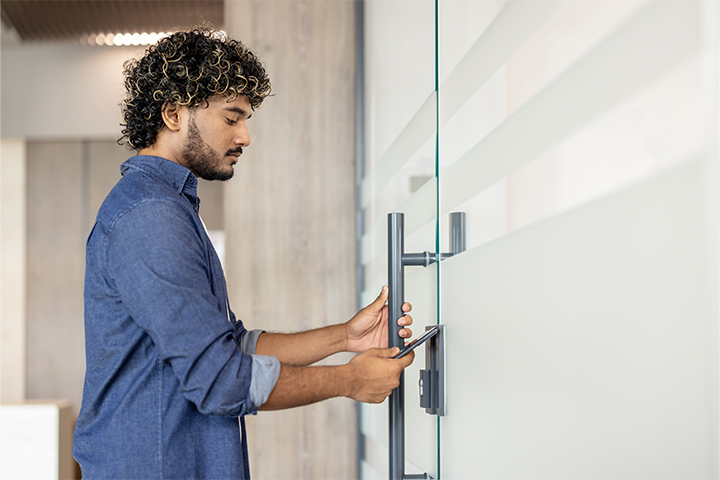
Access control systems take things up a notch by removing the need to rely purely on traditional keys. You can connect them up to your existing systems – be it for logging visitors or clocking in/ out – and get super granular with the level of customisation and access requirements.
14. Use Physical Personnel
Sometimes, there’s no substitute for having someone on-site, particularly in the worst-case scenario where security risks embody an active physical threat: here, I’m thinking harassment cases or direct-action groups. In these instances, visible security presence can be one of the strongest deterrents going.
Common Mistakes You Can Easily Avoid
Before I wrap up on workplace security, allow me to share a few final pointers, because while the best practices are essential to know, so are the common mistakes, so you can avoid them.
- Leaving doors propped open on hot summer days
- Having no sign-in process for visitors
- Sharing keycards or access codes with unauthorised individuals out of ease
- Staff letting in unknown people (“tailgating”)
- Not deactivating access when employees leave
- Having too many people with admin or full access
- Patchy security camera coverage, with gaps in key areas
- Assuming CCTV is enough alone and failing to monitor footage
- Having no clear process if a breach or a theft occurs, including reporting protocols
- Failing to fix faulty locks or broken access systems promptly
- Relying entirely on digital systems, rather than a software x hardware combination.
The Bottom Line: Physical Office Security Starts with Robust Entry Points
A common refrain among locksmiths, yet nonetheless a true one: your property is only as secure as its weakest point of entry.
Thus, for UK businesses, it’s massively important to dedicate serious time to evaluating and upgrading your existing lock systems, using British Standard hardware as the absolute minimum.
With these fundamental safeguards in place, you can then see to additional security solutions, such as access control tech, visitor management systems, and physical ram-proof barriers. It may take some time, but the payoff is invaluable when weighed against the chances of insurance trouble or even legal penalties later down the line.
For lock more security insights, explore the rest of my blog.