Door security is no joke. As the primary entry point and first line of defence to the home – our most intimate spaces – it’s more than just a piece of wood, composite, or uPVC for today’s purposes; it’s just as much a safeguard to your wellbeing and peace of mind. You know what that means? Ploughing on with all due diligence to tackle any gaps in your home security.
Today, that starts with replacing locks on your uPVC doors.
Whether they’ve become crusty from wear and tear, outdated on the safety front, or damaged from misuse or tampering, this locksmith’s guide will set you on the right path. Let’s get into it.
Skip to:
When You Need to Replace a uPVC Door Lock
Issues with uPVC doors are one of the most common reasons I’m called out on emergency trips around York. A gearbox packing in at the end of the school run; a patio door gone awry; a key snapped in the lock cylinder trapping the occupants inside the building; I’ve seen it all.
Now, one thing I’ve learnt over the years is that these sorts of mishaps never happen when it’s most convenient. If anything, it’s completely random. And with Yorkshire’s older housing stock – I’m thinking Victorian town houses, Edwardian terraces and a whole assortment of listed buildings – many homes simply aren’t up to date with their hardware.
To avoid one of these lockout or, indeed, ‘lock-in’ scenarios, it’s best to get prepared as soon as possible. That means being able to tell when your uPVC door locks pose a security risk.
Here’s an inexhaustible list of everything to look out for. You should prioritise replacing the locks on your uPVC door when…
- The lock is sticking, and your key won’t turn properly
- The key snaps inside the cylinder
- You’ve suffered a break-in or a break-in attempt
- The gearbox has failed (which is not uncommon in multi-point systems)
- Your keys are lost, with an untrustworthy person (like an unscrupulous ex-tenant), or have been stolen
- You’ve moved into a new property or bought a rental place
- The lock is more than 10 years old and, thus, isn’t up to scratch with industry-approved performance or home insurance requirements
- You can’t find a kitemark or British Standard number on the lock
- There’s visible damage to the door and its locking mechanism
Identifying Your uPVC Lock Type
It might seem obvious, but this is a frequently overlooked step. Before you can set your lock replacement plans into motion, you need to find out exactly which type of door lock you’re working with. The good news, though, is that it’s deceptively simple.
uPVC doors almost exclusively use multi-point locking systems, which work by securing the door to the frame at several points, typically 3-5. These points operate simultaneously when you lift the handle and turn the key, thereby activating the barrel or euro cylinder lock sitting in the door cavity.
Short and sweet: if you lift your handle and hear several clicks up the door, that’s a multipoint lock, and the cylinder is just one part of it.
Visual Identification Tips
Euro cylinder locks can cause a bit of confusion, since they’re often used in conjunction with the term ‘barrel locks’. Both feature a slightly oval-shaped metal cylinder, with the keyhole protruding ever so slightly out of the door on either side of the handle.
To clear things up, remember: euro cylinders are just a type of barrel lock. The difference lies in their superior security features for preventing forced entry. You can identify them by their unmistakable keyhole-shaped body.
The multi-point mechanism, then, refers to the metal strip running the full height of the door edge and all the hooks, rollers or bolts hidden inside.
If you get stuck, our guide to the most secure door locks is a handy reference.
Replacing a Lock on a uPVC Door (Step-by-Step)
Now you know what you’re replacing, I’m sure you’re keen on changing that door lock. First, though, make sure you have all the right tools.
What You’ll Need for the Job
Lucky days! With the vast majority of uPVC door lock replacements, you’ll only need a handful of items already part of your standard tool kit.
- A screwdriver
- Measuring tape/ruler
- A suitable lubricant (I recommend GT85 or a specialised silicon spray)
- Your new lock (avoid cheap, unbranded options)
How to Change a Euro Cylinder
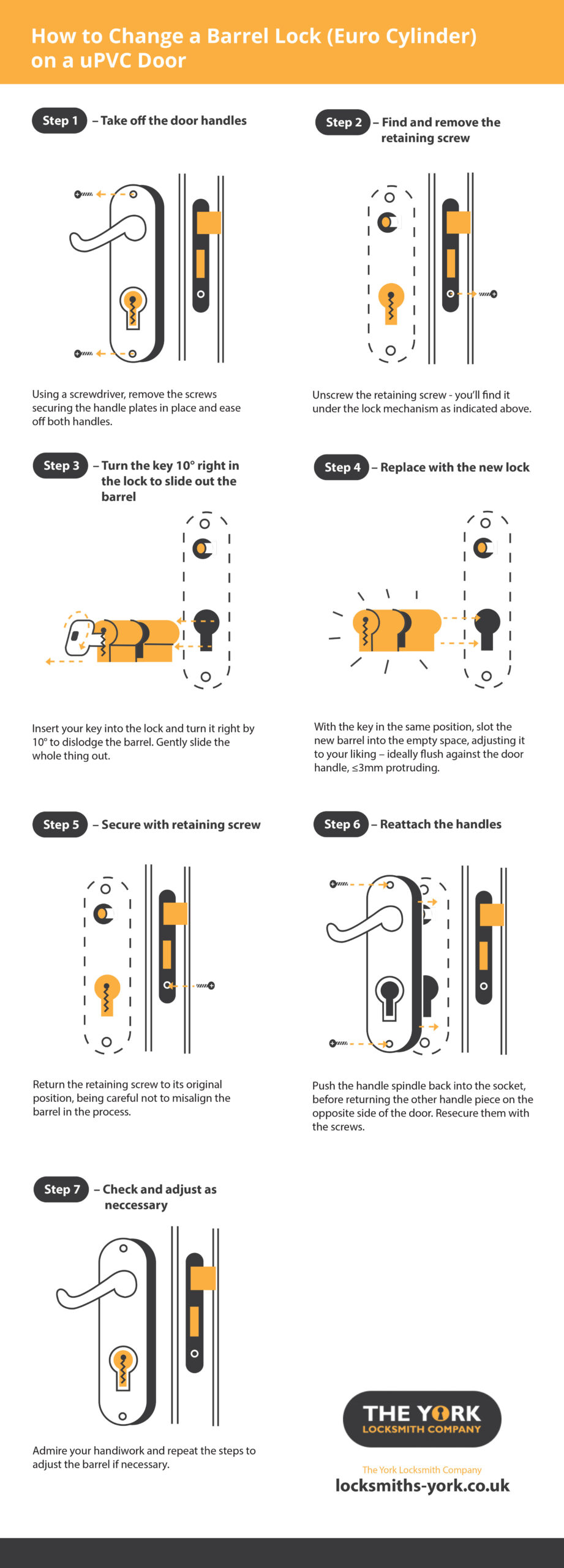
Step 1) Open the door: You’ll need it left ajar to access the screws and complete the overall task. Here, don’t forget to prop it open – you don’t want to be trapped inside!
Step 2) Remove the handles: Find the screw on the handle plate keeping the door handles in place, and use your screwdriver to loosen it. Once removed, you can slide off the handle set and access the barrel.
Step 3) Remove the cylinder retaining screw: Locate the long screw on the edge of the door, in line with the cylinder, and remove it.
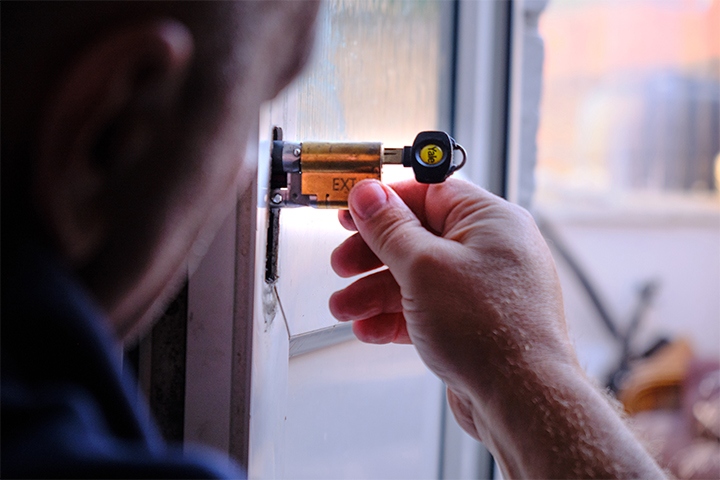
Step 4) Pull out the old cylinder: With the retaining screw out, go ahead and insert your key, turning it 10–15 degrees (left or right) to align the cam with the cylinder body. Now, you can gently ease it out.
Step 5) Measure for the new cylinder: Get the dimensions from the centre of the retaining screw hole to the outside edge, plus the centre to the inside edge. Do not assume that these will be the same, otherwise you might end up with an awkward fit.
Step 6) Install the new cylinder: Slide the new cylinder into the empty slot, insert the key to align the cam, and tighten the retaining screw (but not too tight!).
Step 7) Reattach the handle: Screw the handles back on and test the lock with the door open. You can always readjust if you’re not happy with the alignment.#
Step 8) Give the new lock some lubrication, not WD40! Instead, use GT85 or silicone spray; unlike the oil-based stuff, which tends to gum up the lock mechanism, they’ll properly clear it out and help it run smoother. We locksmiths swear by it.
uPVC Door Lock Mechanisms (Gearbox Issues)
In the case that your door lifts but still won’t lock – even after upgrading the cylinder – it’s likely a gearbox issue on your hands. To fix the door lock in this scenario requires the full locking strip to be removed, faceplate screws and all, and the gearbox being replaced – something I wouldn’t recommend to the average DIYer. Here, any alignment issues could seriously damage your doors, so professional assistance is a must.
How to Choose a Suitable Replacement Lock
A lot rides on your choice of external locks as far as home security is concerned. Remember what I mentioned about your door being your first line of defence? Well, it’s not just me urging homeowners to upgrade their locks to modern, British Standard-compliant hardware.
Following a spate of high-profile jewellery thefts across Yorkshire in early February 2026, West Yorkshire Police has issued a statement to locals. In it, Detective Inspector Jenny Haigh said: “[We] urge residents to make sure their doors are fitted with good quality locks, which for euro cylinder locks, have a TS 007 (3-star rating) or a Sold Secure Diamond Standard for lock cylinders (SS312)”. BS3621 is the equivalent for mortice and cylinder rim locks.
However, it’s not all doom and gloom. Upgrading your door locks also opens the door (see what I did there?) to greater convenience. For example, with a set of keyed alike locks, people don’t need to faff around with cumbersome keychains – a lifesaver if you’re returning home in a downpour!
Time to Put Those Learnings to Action!
The long and short of it is this:
If you’re working with just a euro cylinder, pop down to your local DIY store to buy a replacement once you’ve measured the existing hardware, and get it installed yourself. It’s a 5-minute job that even the most DIY-phobic homeowner can breeze through – proof in the pudding being our simple tutorial.
On the flipside, if your uPVC door features a multipoint locking mechanism or you’re stumped with a gearbox issue, this is your cue to call in the professionals. A reputable local locksmith should get to you in the nick of time for emergencies and resolve your problem affordably, without damaging your door.
Sounds ideal? Then get in touch with me, Steve, your trusted Yorkshire locksmith.